Social Media & Politics
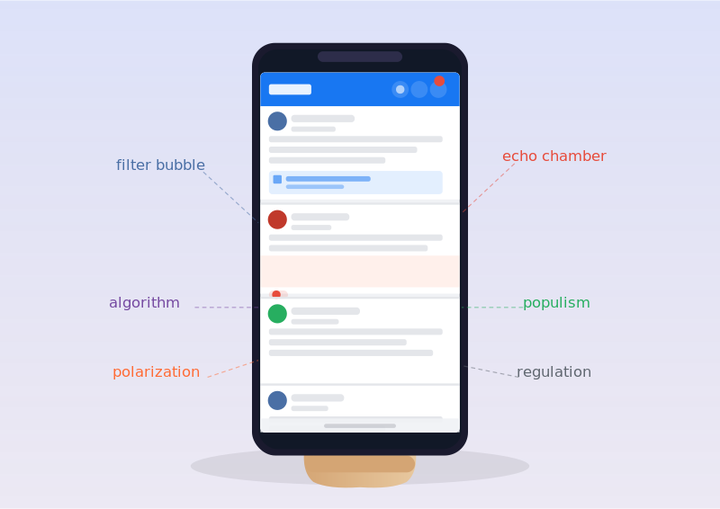
Social media is the most important news source for young generations. But how does social media affect political communication, elections and politics in general? In this course, we will discuss basic theories of digitalization, relevant political actors, media effects, polarization, filter bubbles, rabbit holes, populism, and platform regulation.
Sessions & readings
Intro to the course
Political communication in the social media age
- Jungherr, A., & Schroeder, R. (2021). Digital Transformations of the Public Arena. Cambridge University Press.
Political actors: who communicates on social media
- Jungherr, A. (2023). Digital campaigning: how digital media change the work of parties and campaign organizations and impact elections. In Research Handbook on Digital Sociology.
- Riedl, M. J., Lukito, J., & Woolley, S. C. (2023). Political influencers on social media: An introduction. Social Media + Society, 9(2).
- Keller, T. R., & Klinger, U. (2019). Social bots in election campaigns: Theoretical, empirical, and methodological implications. Political Communication, 36(1), 171–189.
Media effects: is social media dangerous or just noise?
- Zhuravskaya, E., Petrova, M., & Enikolopov, R. (2020). Political effects of the internet and social media. Annual Review of Economics, 12(1), 415–438.
- Allcott, H., Gentzkow, M., Mason, W., Wilkins, A., Barberá, P., Brown, T., et al. (2024). The effects of Facebook and Instagram on the 2020 election: A deactivation experiment. Proceedings of the National Academy of Sciences, 121(21).
- Piccardi, T., Saveski, M., Jia, C., Hancock, J., Tsai, J. L., & Bernstein, M. S. (2025). Reranking partisan animosity in algorithmic social media feeds alters affective polarization. Science, 390(6776).
- Guess, A. M., Malhotra, N., Pan, J., Barberá, P., Allcott, H., Brown, T., et al. (2023). How do social media feed algorithms affect attitudes and behavior in an election campaign? Science, 381(6656), 398–404.
Algorithmic bias
- Bandy, J. (2021). Problematic machine behavior: A systematic literature review of algorithm audits. Proceedings of the ACM on Human-Computer Interaction, 5(CSCW1).
- Ibrahim, H., Jang, H., Aldahoul, N., Kaufman, A., Rahwan, T., & Zaki, Y. (2025). TikTok’s recommendations skewed towards Republican content during the 2024 U.S. presidential race.
- Hosseinmardi, H., Ghasemian, A., Rivera-Lanas, M., Horta Ribeiro, M., West, R., & Watts, D. J. (2024). Causally estimating the effect of YouTube’s recommender system using counterfactual bots. Proceedings of the National Academy of Sciences, 121(8).
- Gauthier, G., Hodler, R., Widmer, P., et al. (2026). The political effects of X’s feed algorithm. Nature.
Gender bias
- Tsichla, E., Lappas, G., Triantafillidou, A., & Kleftodimos, A. (2023). Gender differences in politicians’ Facebook campaigns. New Media & Society, 25(11), 2918–2938.
- Guilbeault, D., Delecourt, S., & Desikan, B. S. (2025). Age and gender distortion in online media and large language models. Nature, 646(8087).
- Lambrecht, A., & Tucker, C. (2019). Algorithmic bias? An empirical study of apparent gender-based discrimination in the display of STEM career ads. Management Science, 65(7), 2966–2981.
Echo chambers, filter bubbles & polarization
- Barberá, P. (2020). Social media, echo chambers, and political polarization. In Social Media and Democracy: The State of the Field, Prospects for Reform, 34–55.
- Levy, R. (2021). Social media, news consumption, and polarization: Evidence from a field experiment. American Economic Review, 111(3), 831–870.
- Bail, C. A., et al. (2018). Exposure to opposing views on social media can increase political polarization. Proceedings of the National Academy of Sciences, 115(37), 9216–9221.
- Guess, A. M., & Lyons, B. A. (2020). Misinformation, disinformation, and online propaganda. In Social Media and Democracy: The State of the Field, Prospects for Reform, 10–33.
Social media in practice: political social media consulting (Guest: Martin Fuchs)
Social media in practice: platform regulation (Guest: Julian Jaursch)
- Gorwa, R. (2024). Regulating platform companies: A cross-domain policy overview. In The Politics of Platform Regulation. Oxford University Press.
Social media in practice: government communication on social media (Guest: Josef Hinterseher)
Cross-platform comparison
- Bossetta, M. (2018). The digital architectures of social media: Comparing political campaigning on Facebook, Twitter, Instagram, and Snapchat in the 2016 U.S. elections. Journalism & Mass Communication Quarterly, 95(2), 471–496.
- Boulianne, S., Hoffmann, C. P., & Bossetta, M. (2025). Social media platforms for politics: A comparison of Facebook, Instagram, Twitter, YouTube, Reddit, Snapchat, and WhatsApp. New Media & Society, 27(11), 6006–6037.
- Li, M., Suk, J., Zhang, Y., Pevehouse, J. C., Sun, Y., Kwon, H., et al. (2026). Platform affordances, discursive opportunities, and social media activism: A cross-platform analysis of #MeToo on Twitter, Facebook, and Reddit, 2017–2020. New Media & Society, 28(1), 119–147.
- Ridout, T. N., Neumann, M., Yao, J., Baum, L., Franz, M. M., Oleinikov, P., & Franklin Fowler, E. (2024). Platform convergence or divergence? Comparing political ad content across digital and social media platforms. Social Science Computer Review, 42(5), 1181–1203.
- Lee, S., Nanz, A., & Heiss, R. (2022). Platform-dependent effects of incidental exposure to political news on political knowledge and political participation. Computers in Human Behavior, 127.
Populism and social media: are populists better at social media?
- Jungherr, A., Schroeder, R., & Stier, S. (2019). Digital media and the surge of political outsiders: Explaining the success of political challengers in the United States, Germany, and China. Social Media + Society, 5(3).
- Mosca, L., & Quaranta, M. (2021). Are digital platforms potential drivers of the populist vote? A comparative analysis of France, Germany and Italy. Information, Communication & Society, 24(10), 1441–1459.
- González-Bailón, S., d’Andrea, V., Freelon, D., & De Domenico, M. (2022). The advantage of the right in social media news sharing. PNAS Nexus, 1(3).
- Davidson, T. R., & Enos, J. (2024). Engaging populism? The popularity of European populist political parties on Facebook and Twitter, 2010–2020. Political Communication, 42(1), 171–200.
Final discussion: should we ban social media? / exam prep

Jasper Dag Tjaden
Professor for Applied Social Research and Public Policy
Have a look at recent publication via Google Scholar.